Students today have a difficult time with research. I understand that research is often time consuming and requires intermediate-to-advanced reading skills as well as critical thinkings skills. I also understand that 5 classes of middle schoolers may not be the best way to judge. That said, please allow me to share my observations.
The Project
Another teacher and I created a research project to help students contextualize the reading, writing, listening, and speaking skills we have been practicing all year. Students would choose their own topic, research it using several online sources, create a slideshow, and present it to the class. We designed the project to proceed through the steps slowly, knowing that many students have never done something on this scale.
We started with a graphic organizer that walked students through the brainstorm process, how to choose a topic, and how to develop research questions.
We included visual examples, written and spoken directions, and divided them into small groups so they could help each other if they got stuck.
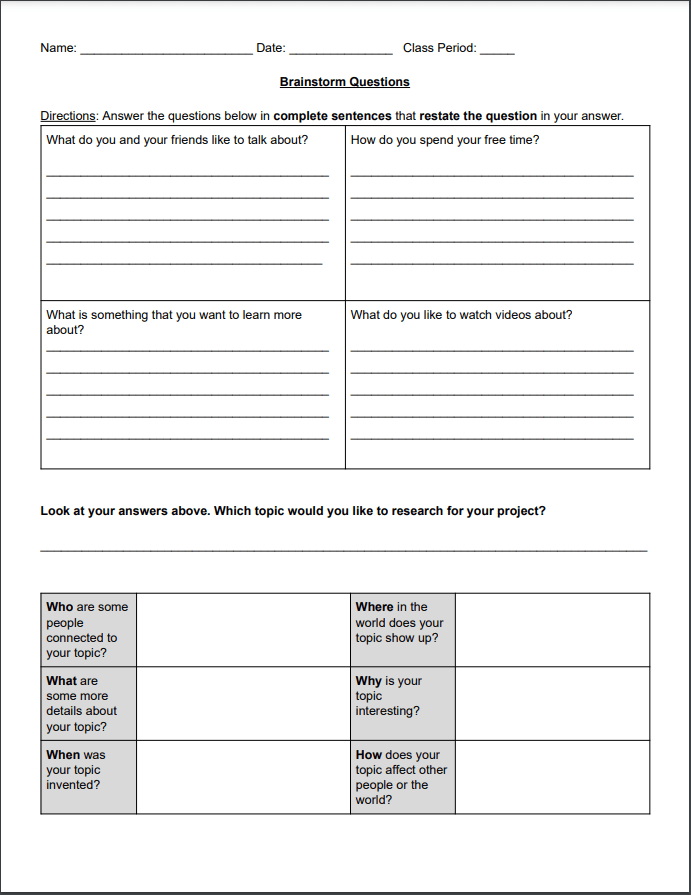
This part went slowly but ended up mostly successful since many students were excited to learn more about the topics they chose, which ranged from florists to Fortnite and from sports brands to the origin of ice cream.
The Problem
We ran into trouble during the next step, which was finding websites and taking notes on those websites in order to answer their research questions.
We designed flowcharts to help students visualize the step by step process of finding a trustworthy and helpful website. We walked them through it multiple times with visual examples, and we scheduled times to work with each small group with as close to 1-on-1 instruction as you can get in a classroom of 20+ students.
Despite this, students had a very difficult time accepting one simple idea: Google’s AI Overview was NOT a website and NOT their answer.
I cannot recount the number of times I had to clarify that they were not allowed to use the first answer at the top of the page. Students argued and complained about why they have to read a whole website if Google can simply give them the answer.
This leads me to asking them: “Is everything on the internet trustworthy?”
Which they universally answer: “No.”
To which I respond: “Then why are you treating the first answer that comes up as the truth?”
The Bigger Issue
I understand these are kids, all of whom were greatly impacted by COVID learning losses, but I do not think they are the only ones making these mistakes. I am concerned that it is a full cultural phenomenom: that we are — for many different reasons — not taking the time to do our own research. We are instead taking the first result that pops up on Google and not tracking down valid sources.
This is a serious problem because those top answers are easily manipulated. We know that AI makes up information, and that AI is capable of straight-up lying. We have also known for years that Google and many social media platforms alter their search results based on our preferences. And since this is all happening already, it is not difficult to imagine that a corrupt government could also manipulate the information to show more/only answers that agree with their agendas.
So I appeal to you — in a time when government leaders are calling for the removal of judges who disagree with them, attempting to remove watchdog groups, and shuttering unions that dissent with their opinions — please take the time to teach your kids how to do research.
 Grant Pearson
Leave a comment